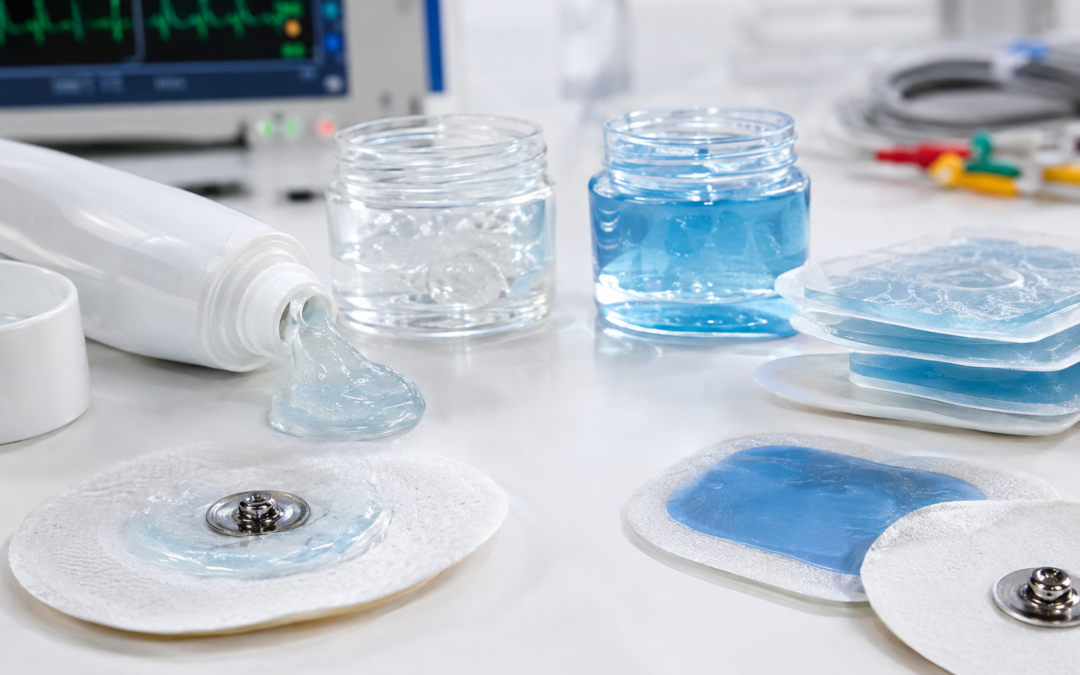
Understanding Electrode Gel and Hydrogel
An electrode gel provides a conductive interface between the skin and the electrode. In applications such as ECG, the conductive medium helps reduce skin-electrode impedance and supports transmission of the body’s electrical signals to the sensing element. The FDA identifies conductive gel, electrode construction, electrical performance, adhesive performance, biocompatibility, and shelf life as important considerations for ECG electrode designs.
Wet gels generally contain water, electrolytes, and other formulation components that create an ionic conduction path. Because they can conform closely to the skin, they can provide effective electrical coupling.
Hydrogels use a polymer matrix to hold water and electrolytes in a more stable structure. Depending on the formulation, a hydrogel can range from relatively soft and tacky to firmer solid material.
This distinction matters because the physical state of the conductive material affects how it behaves during application, storage, handling, and use.
Signal Quality: Wet Gel Has a Strong Starting Point
Signal quality is usually one of the first concerns when selecting an electrode interface.
A wet electrode gel can provide excellent skin contact because the liquid or semi-liquid material spreads across microscopic variations in the skin. Water and electrolyte content help establish an ionic pathway between the skin and electrode, reducing contact impedance. Research on surface biopotential electrodes has found that gel electrodes commonly provide strong signal quality because the conductive gel reduces skin-electrode impedance.
This can be particularly valuable for short-duration diagnostic measurements where obtaining a clean signal quickly is important.
However, the same properties that make wet gel effective can create limitations. Liquid formulations can migrate, spread, or lose moisture over time. As the gel dehydrates, impedance can increase and signal quality may deteriorate. Research examining hydrogel-based ECG electrodes has similarly identified dehydration as a factor that can increase impedance and noise during longer measurements.
Solid hydrogel takes a different approach. Its polymer structure retains moisture and keeps the conductive material in a defined location. This can provide more consistent physical behavior over the wear period.
For a device intended for longer monitoring, therefore, a properly engineered hydrogel may offer an advantage in maintaining a stable interface.
Shelf Life and Storage Considerations
Shelf life is not determined by the gel alone. The finished electrode, packaging, adhesive, conductive layer, backing, and storage environment all contribute to long-term stability.
For disposable ECG electrodes, the FDA recommends shelf-life testing on representative finished products and evaluation of critical performance parameters throughout the proposed shelf life.
Wet formulations can require careful packaging because water loss can change the material’s physical and electrical properties. A package that does not adequately control moisture transmission may contribute to drying before the product reaches the end user.
Solid hydrogels can simplify moisture retention because water is incorporated into a polymer network. That does not mean every solid hydrogel automatically has a longer shelf life. Formulation chemistry, packaging, environmental exposure, and storage temperature still need to be validated.
For product developers, the practical lesson is simple: do not select a gel based on material performance alone. Evaluate the gel inside the complete packaged electrode.
A promising laboratory formulation can behave very differently after months of storage.
Mess and User Experience
Wet gel can be highly effective, but handling can be less convenient.
If the formulation is fluid enough to move outside the intended electrode area, users may experience residue or cleanup requirements. This can matter in clinical environments where electrodes are applied and removed frequently.
Solid hydrogel generally provides a cleaner user experience because the conductive material stays within a defined layer. Some electrode manufacturers specifically distinguish wet, solid, and hydrogel formats based on handling, cleanup, and intended applications.
The user experience also extends beyond cleanup. A hydrogel can potentially provide a softer and more conformable skin interface while maintaining its shape during application.
For wearable devices, this can be especially important. The electrode must maintain contact while the user moves, sweats, sleeps, exercises, or wears the device for extended periods.
Adhesion and Skin Conformability
Conductivity is only one part of electrode performance.
The electrode must stay in contact with the skin, and the interface must accommodate movement without producing excessive artifacts. The FDA recommends evaluating adhesive performance under intended conditions of use, including situations involving perspiration or strenuous activity when relevant to the product’s labeling.
A hydrogel can sometimes contribute both electrical coupling and physical conformity. However, it should not be assumed that the hydrogel is responsible for all adhesion. Many electrode constructions use a separate pressure-sensitive adhesive surrounding or supporting the conductive area.
This creates an important development consideration: the conductive material and adhesive system need to be designed together.
Changing the hydrogel formulation can alter tack, moisture behavior, skin feel, or compatibility with surrounding adhesive layers. A change that improves conductivity might create problems elsewhere in the finished device.
Manufacturability at Volume
A material that performs well in a prototype may not automatically be the best choice for mass production.
Wet gels can introduce challenges involving dispensing, metering, containment, filling, and packaging. Production equipment must consistently deliver the correct amount of material to the intended location. Too little gel can affect electrical performance, while too much can create migration, contamination, or packaging problems.
Solid hydrogels can provide more predictable geometry after forming and can be easier to handle in some converting operations. However, they may introduce their own manufacturing requirements, including controlled formulation, casting, curing, die cutting, lamination, and handling.
The ideal choice depends on the manufacturing platform.
For example, a device designed around roll-to-roll processing may have very different material requirements than a low-volume clinical electrode assembled through manual or semi-automated operations.
Manufacturing teams should therefore evaluate:
- Material viscosity or firmness
- Dispensing or coating requirements
- Cure or conditioning requirements
- Dimensional consistency
- Die-cutting behavior
- Lamination compatibility
- Release-liner compatibility
- Packaging requirements
- Lot-to-lot variation
- Production yield
- Inspection requirements
- Storage and transportation stability
A conductive material that requires extensive manual handling may become expensive when production volumes increase.
Cost Is More Than the Price Per Kilogram
Comparing material prices alone can lead to poor decisions.
Suppose one electrode gel formulation is inexpensive but requires specialized packaging and creates higher production waste. Another hydrogel may cost more per unit of raw material but produce better dimensional consistency and fewer rejected parts.
The second option may ultimately have a lower total cost.
Manufacturers should consider the entire cost structure, including raw materials, packaging, production labor, equipment, scrap, testing, inventory, shipping, and shelf-life requirements.
At higher volumes, even a small reduction in material waste or production variation can have a meaningful financial impact.
When Wet Electrode Gel Makes More Sense
Wet gel can be an excellent choice when the primary requirement is rapid and effective skin-electrode coupling.
It may be particularly appropriate for applications involving:
- Short-duration ECG testing
- Diagnostic measurements
- Clinical electrodes
- Applications where rapid signal acquisition matters
- Reusable electrode systems
- Devices where gel dispensing is already established
- Applications where cleanup is manageable
Wet gel is not inherently an inferior technology. In the right device architecture, it can provide excellent electrical performance and a proven user workflow.
When Solid Hydrogel Makes More Sense
Solid hydrogel can be attractive when the device needs a more controlled conductive interface.
Potential advantages include:
- Reduced material migration
- Cleaner handling
- Consistent material placement
- Better resistance to dehydration in some formulations
- Suitability for longer wear
- Compatibility with compact disposable electrode designs
- Potentially simplified assembly in certain production environments
The correct choice still depends on the specific formulation and finished electrode. A poorly engineered hydrogel can perform worse than a well-designed wet gel.
Validation Should Drive the Final Decision
The best material should be selected through testing rather than assumptions.
For ECG-type electrodes, relevant performance evaluations can include AC impedance, DC offset, defibrillation overload recovery, bias current tolerance, adhesive performance, biocompatibility, and shelf-life testing. FDA guidance specifically identifies these electrical and physical performance areas for ECG electrode development.
Testing should be performed using the actual electrode construction rather than evaluating the conductive material in isolation.
A practical development process may include:
- Define the intended wear duration.
- Identify required electrical performance.
- Select candidate wet gel and hydrogel formulations.
- Evaluate skin compatibility.
- Test adhesion and movement.
- Measure electrical performance before and after aging.
- Evaluate packaging and moisture retention.
- Test production compatibility.
- Run pilot-scale manufacturing.
- Validate the finished packaged device.
This approach helps identify problems before the design reaches full-scale production.
Working With an Experienced Medical Product Partner
Material selection becomes more complicated when a product moves from prototype to commercial manufacturing. Formulation, electrode construction, adhesive selection, converting, packaging, testing, and regulatory documentation can all interact.
This is where working with an experienced development and manufacturing partner can be valuable. R & D Medical Products can be relevant when device developers need support translating material requirements into a manufacturable electrode design.
The objective should not simply be to find an electrode gel that works in a laboratory test. The goal is to create an electrode system that performs consistently throughout its intended life cycle.
That means considering the interaction between the conductive medium, electrode substrate, adhesive, packaging, manufacturing process, and end-user environment.
Making the Final Choice
So, which belongs in your device?
The answer depends on what the device needs to accomplish.
Wet electrode gel can be a strong choice when rapid, low-impedance skin contact and established clinical workflows are priorities. Solid hydrogel can be attractive when controlled placement, cleaner handling, long-wear performance, and production consistency are more important.
Neither option should be selected based solely on conductivity or material cost.
The strongest development strategy is to compare both materials under the actual conditions your device will face. Test the finished electrode after storage, during wear, under movement, and through the manufacturing process.
Ultimately, the best conductive interface is the one that provides the required signal quality while also meeting your targets for comfort, stability, shelf life, manufacturability, and cost.
Frequently Asked Questions
Is electrode gel the same as hydrogel?
Not always. Electrode gel is a broad term for conductive material used to create an electrical interface between the electrode and skin. Hydrogel generally refers to a water-containing polymer network. Some electrode hydrogels are solid or semi-solid, while wet gels are more fluid.
Which provides better signal quality, wet gel or hydrogel?
Both can provide strong signal quality when properly formulated. Wet gel can provide excellent initial skin coupling, while a well-designed hydrogel may provide more stable physical contact over longer periods. Actual performance should be confirmed through testing of the finished electrode.
Does hydrogel have a longer shelf life?
It can, but there is no universal shelf-life advantage. Packaging, formulation, adhesive chemistry, storage conditions, and the finished electrode design all influence shelf life. Real-time and appropriate accelerated stability studies should be used to establish the actual expiration period.
Is solid hydrogel less messy than wet electrode gel?
Generally, solid hydrogel is easier to contain and handle because it does not flow like a liquid or semi-liquid formulation. This can reduce residue and cleanup requirements, although the exact experience depends on the formulation and electrode construction.
Which material is better for high-volume manufacturing?
There is no universal answer. Wet gel may work well with established dispensing and packaging processes, while solid hydrogel may provide advantages in controlled placement and converting. Pilot production should be used to evaluate yield, consistency, equipment compatibility, and total manufacturing cost.
What should manufacturers test before selecting an electrode material?
Testing can include electrical performance, adhesion, biocompatibility, skin compatibility, dehydration behavior, shelf life, packaging stability, and manufacturing consistency. For ECG electrodes, applicable performance evaluations include AC impedance, DC offset, defibrillation overload recovery, and bias current tolerance.