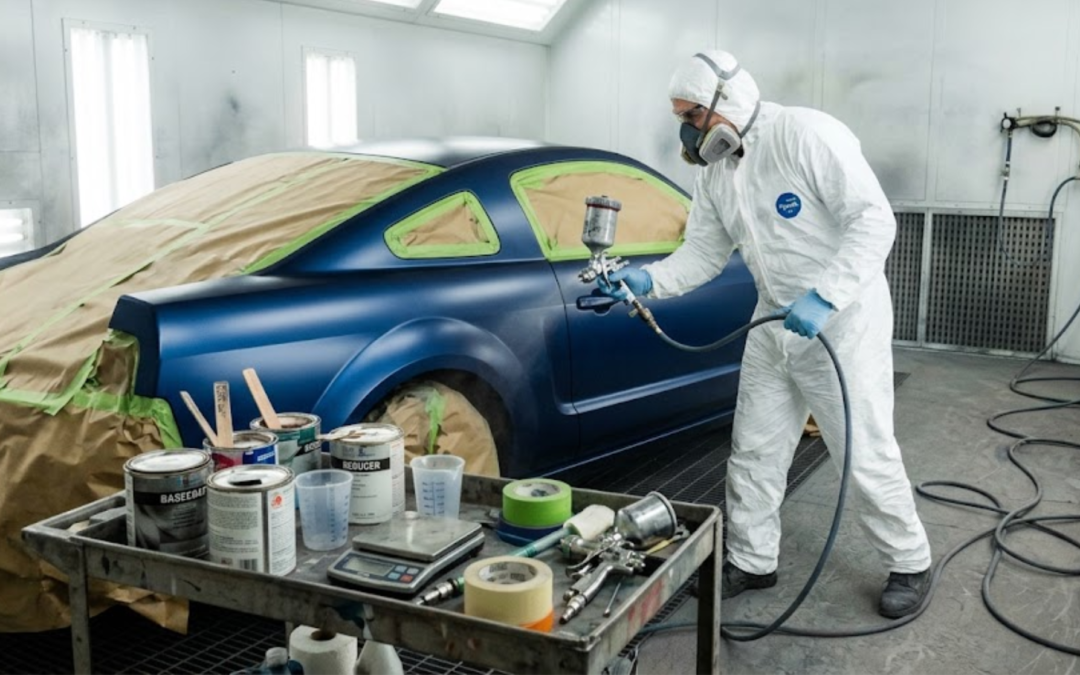
Achieving a flawless, factory-quality finish on a vehicle is both an art and an exact science. Whether you are performing a localized spot repair, executing a full vehicle respray, or customizing a build, the final visual outcome depends heavily on the paint system you apply. At the heart of modern automotive refinishing is the two-stage paint process, where the base coat performs the critical job of delivering rich color, coverage, and visual depth.
Understanding how base coats function, how they interact with clear coats, and how to apply them properly is essential for achieving professional, long-lasting results in automotive restoration and repair.
What Is an Automotive Base Coat?
An automotive base coat is the primary color layer applied over a prepared primer surface. In a traditional two-stage (or multi-stage) refinishing system, the base coat provides the color, metallic shimmer, or pearlescent effect, but it does not provide gloss or protection against environmental elements.
Unlike single-stage paints which combine color and high-gloss protection in a single layer, a base coat dries to a flat, matte, or satin finish. It relies entirely on a clear topcoat to seal the paint, provide UV protection, add chemical resistance, and supply the high-gloss shine expected of modern vehicles.
Key Types of Base Coat Formulations
Automotive base coats come in various chemical formulations and visual effects to match different OEM (Original Equipment Manufacturer) standards:
- Solvent-Borne Base Coats: Traditional solvent-based systems remain widely popular due to their fast drying times, predictable application, and ease of blending. They offer crisp metallic alignment and excellent durability when properly cleared.
- Waterborne Base Coats: Engineered to meet strict environmental regulations and lower Volatile Organic Compound (VOC) emissions, waterborne systems are now standard in many commercial body shops and OEM manufacturing facilities. They provide exceptional color accuracy and opacity.
- Solid Colors: Simple, non-metallic shades that provide clean, uniform tone without reflective particles.
- Metallic and Pearl Effects: Base coats infused with fine aluminum flakes or ground mica particles that refract light, giving vehicles a dynamic, multi-dimensional look under bright sunlight.
Why the Two-Stage System Matters
The transition from older single-stage lacquers and enamels to modern two-stage systems revolutionized the automotive industry. Separating the color layer from the protective layer offers several distinct advantages:
- Color Accuracy: Technicians can match OEM factory finishes with incredible precision, blending seamlessly into surrounding panels.
- Longevity and UV Resistance: The top clear coat acts as a shield, shielding the underlying base coat from oxidation, sun fading, bird droppings, and surface scratches.
- Ease of Repair: Spot repairs and panel blending are significantly simpler with two-stage systems compared to trying to blend high-gloss single-stage finishes.
When selecting products for your refinishing projects, using premium-grade Automotive Basecoat paints ensures consistent viscosity, superior hide, and reliable chemical bonding with your clear coat layer.
Best Practices for Applying Automotive Base Coat
To ensure a seamless, smooth finish without defects like orange peel, tiger stripes, or solvent pop, follow these core surface preparation and application practices:
1. Thorough Surface Preparation
Paint is only as good as the surface beneath it. Clean the repair area thoroughly with a dedicated grease and wax remover. Sand the primer with fine-grit sandpaper (typically 600 to 800 grit for wet sanding) to create an optimal mechanical bond without leaving visible scratches.
2. Environment and Temperature Control
Temperature and humidity dramatically affect base coat flash times and atomization. Always check the manufacturer’s technical data sheet (TDS) for the correct reducer speed (slow, medium, or fast) matched to your shop’s ambient temperature.
3. Spray Gun Technique
Maintain a consistent gun distance (usually 6 to 8 inches from the panel) with a 50% to 75% overlap on each pass. For metallic base coats, apply a lighter “drop coat” or “orientation coat” at a slightly lower pressure to ensure the metallic flakes lay evenly without pooling.
4. Adequate Flash Time
Allow each coat of base paint to fully flash off (dry to a dull finish) before applying the next layer or the clear coat. Trapping solvents between layers can cause loss of gloss, blistering, or delamination down the road.
Conclusion
The quality of your base coat application directly dictates the final visual quality of any automotive paint job. By selecting high-performance formulations, mastering surface preparation, and strictly adhering to flash-off timing, refinishing professionals and dedicated enthusiasts can achieve seamless OEM-level results that stand the test of time.
Frequently Asked Questions (FAQs)
Q: Can I apply clear coat directly over an old base coat without sanding?
A: No. Base coats must be clear-coated within a specific window (usually within 24 hours). If the base coat has fully cured past that window, it must be scuffed lightly and reapplied to ensure proper adhesion with the clear coat.
Q: How many coats of base coat are typically required?
A: Most automotive applications require 2 to 3 full coverage coats to achieve complete opacity and proper metallic orientation, followed by a final light drop coat for metallic or pearl finishes.
Q: What happens if you don’t use reducer in base coat paint?
A: Base coat paint is designed to be thinned with a compatible solvent or reducer. Without reducer, the paint will be too thick to atomize through a spray gun, leading to heavy texture, uneven coverage, and poor leveling.